

Content creation has hit a breaking point. Businesses need more content than ever, but hiring enough writers to keep up isn't realistic for most teams. That's where ai content generators come in, and they've gotten remarkably good at what they do.
I've spent the past few months testing every major AI writing tool I could get my hands on. Some impressed me. Others felt like they were still stuck in 2023. The difference between the best and worst options is massive, and choosing the wrong one can waste both time and money.

Why AI Content Generators Matter Now More Than Ever
The content demands on modern businesses are frankly insane. You need blog posts, social media updates, email campaigns, product descriptions, ad copy, and more. All of it needs to be high-quality, on-brand, and published consistently.
Traditional content creation can't scale to meet these demands without ballooning budgets. A single blog post might take a writer 3-4 hours to research, write, and edit. Multiply that across dozens of pieces per month, and you're looking at serious resource constraints.
AI content generators solve the scalability problem. They can draft content in minutes instead of hours, handle multiple content types simultaneously, and work around the clock. But here's the thing: they're not magic. The output quality varies wildly between tools, and you still need human oversight to ensure accuracy and brand alignment.
What to Look for in AI Content Generators
Not all ai content generators are created equal. After testing dozens of tools, I've identified the key factors that separate the winners from the also-rans.

Output quality is obviously critical. The best tools produce content that reads naturally and requires minimal editing. Poor tools generate robotic, repetitive text that screams "AI wrote this."
Versatility matters too. Can the tool handle blog posts, social media, emails, and ad copy? Or is it limited to one content type? The more versatile tools offer better value.
Pricing structure varies significantly. Some tools charge per word, others offer unlimited plans, and a few have generous free tiers. You'll want to calculate your actual cost based on your content volume.
Ease of use can't be overlooked. A powerful tool that's confusing to use won't get adopted by your team. The interface should be intuitive, with clear prompts and helpful templates.
Integration capabilities determine how well the tool fits into your existing workflow. Does it connect with your CMS, social media platforms, or project management tools?
How We Tested and Compared These Tools
I tested each tool with the same set of prompts across different content types: a 1,500-word blog post, social media captions, email subject lines, and product descriptions. This gave me a consistent baseline for comparison.
For each tool, I evaluated output quality, generation speed, ease of use, and value for money. I also tested how well each handled complex prompts versus simple ones, and whether the content required heavy editing or was usable with minor tweaks.
Pricing was assessed based on actual usage patterns, not just the sticker price. A tool with unlimited generation at a higher monthly cost might actually be cheaper than a per-word pricing model if you create lots of content.
The 7 Best AI Content Generators Compared
ChatGPT: Best for Prompt Understanding and Versatility
ChatGPT has become the default AI writing tool for many people, and for good reason. It understands complex prompts better than most alternatives and can handle virtually any content type you throw at it.
The free tier gives you access to GPT-3.5, which is decent for basic content. The paid ChatGPT Plus subscription unlocks GPT-4, which produces noticeably better output. The difference is especially apparent in longer content where coherence and logical flow matter.
What sets ChatGPT apart is its conversational interface. You can refine outputs through follow-up prompts, ask it to adjust tone or length, and iterate until you get exactly what you need. This flexibility makes it incredibly versatile.
The downside? It lacks specialized features for content marketing. There are no built-in templates, SEO optimization tools, or brand voice settings. You're working with a blank slate every time, which can be inefficient for repetitive tasks.
Best for: Writers who want maximum flexibility and don't mind crafting detailed prompts. Also great for one-off content needs across various formats.
Jasper AI: Best for Marketing and Business Content
Jasper AI positions itself as the AI content platform for businesses, and it delivers on that promise with marketing-focused features that ChatGPT lacks.
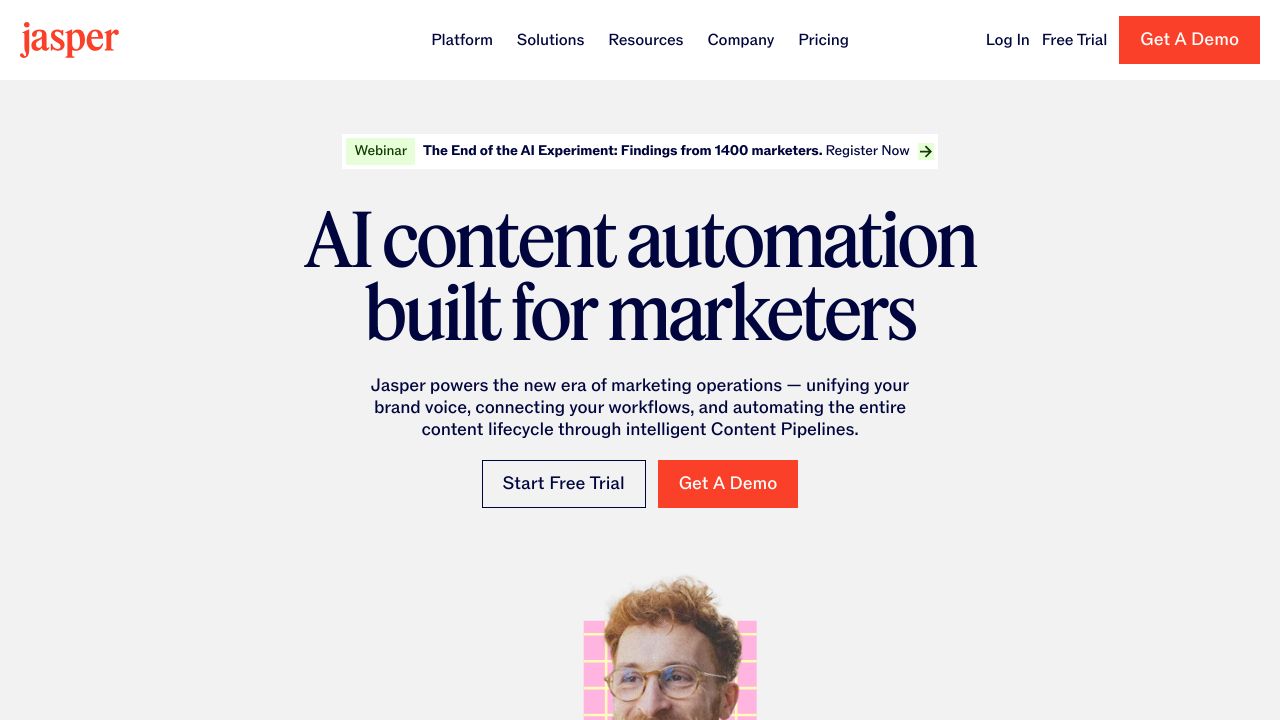
The template library is extensive, covering everything from blog post outlines to Facebook ad copy. These templates guide you through the content creation process with specific fields for your input, making it faster to generate usable content.
Brand voice is where Jasper really shines. You can train it on your existing content to match your company's tone and style. This consistency is valuable when multiple team members are creating content.
The pricing is steep compared to other options. Plans start at a higher price point, and you'll need the more expensive tiers to access advanced features. For small businesses or individual creators, this might be hard to justify.
Best for: Marketing teams and businesses that need consistent, on-brand content at scale. The investment makes sense if you're producing high volumes of marketing materials.
Copy.ai: Best for Quick Copy Generation
Copy.ai excels at generating short-form content quickly. If you need social media posts, email subject lines, or ad copy, this tool can pump them out faster than you can read them.
The interface is straightforward. Select a template, fill in a few fields, and get multiple variations instantly. This speed is perfect for brainstorming or when you need options to choose from.
Workflow automation features let you chain together multiple steps. You could generate a blog outline, expand it into full sections, and create social media posts promoting it, all within the same workflow.
Long-form content isn't Copy.ai's strength. While it can generate blog posts, the quality doesn't match specialized long-form tools. The content tends to be more surface-level and requires significant editing.
Best for: Social media managers and marketers who need lots of short-form content variations quickly. Also useful for brainstorming and overcoming writer's block.
Writesonic: Best for SEO-Optimized Content
Writesonic integrates SEO tools directly into the content creation process, making it easier to optimize as you write rather than as an afterthought.
The article writer feature analyzes top-ranking content for your target keyword and suggests structure, headings, and topics to cover. This data-driven approach helps ensure your content is comprehensive and competitive.
Real-time SEO scoring shows how well your content is optimized as you write. You can see keyword density, readability scores, and suggestions for improvement without switching between tools.
The output quality is solid but not exceptional. Content reads well and covers topics thoroughly, but it sometimes lacks the depth and unique insights that make content truly stand out.
Best for: Content creators focused on search rankings who want SEO guidance built into their writing tool. Particularly useful for blog content and informational articles.
Grammarly: Best for Editing and Enhancement
Grammarly isn't primarily a content generator, but its AI-powered writing assistance has evolved to include generative features that complement its editing capabilities.
The tone detection and adjustment features are incredibly useful. Grammarly can identify whether your writing sounds formal, casual, confident, or uncertain, and suggest changes to hit your target tone.
Generative AI features let you rewrite sentences, expand ideas, or generate new paragraphs based on your existing content. This works well for improving drafts rather than creating from scratch.
The browser extension integrates with virtually every writing platform, from Gmail to Google Docs to WordPress. This ubiquity makes it easy to maintain consistent quality across all your writing.
Best for: Writers who want to improve their own writing rather than generate content from scratch. Excellent as a complement to other AI content generators.
Wordtune: Best for Rewriting and Refinement
Wordtune specializes in rewriting and refining existing content. If you've got a rough draft that needs polish, this tool can transform it quickly.
The rewrite suggestions are contextual and varied. For any sentence, you'll get multiple alternatives that change tone, length, or formality. This makes it easy to find the perfect phrasing.
Expand and shorten features let you adjust content length without losing meaning. Need to hit a word count? Expand. Need to be more concise? Shorten. Both work surprisingly well.
Like Grammarly, Wordtune isn't designed for generating content from scratch. It's a refinement tool that works best when you already have something written.
Best for: Editors and writers who need help refining drafts. Also useful for non-native English speakers looking to improve their writing quality.
Rytr: Best Budget-Friendly Option
Rytr offers solid AI content generation at a fraction of the cost of premium tools. The free tier is generous, and paid plans are affordable even for individual creators.
The feature set covers most common content needs: blog posts, social media, emails, and more. While it doesn't have the advanced capabilities of pricier tools, it handles basic content creation competently.
Output quality is decent but not exceptional. Content tends to be more generic and requires more editing than premium alternatives. But for the price, it's hard to complain.
The interface is clean and straightforward. You won't find complex workflows or advanced features, but that simplicity can be an advantage if you just need to generate content quickly.
Best for: Small businesses, freelancers, and individual creators on tight budgets who need basic AI content generation without premium pricing.
Side-by-Side Comparison: Features, Pricing, and Performance
Pricing Comparison Breakdown
Pricing structures vary dramatically across ai content generators, making direct comparisons tricky. Some charge per word, others offer unlimited generation, and a few use credit systems.
Tool | Free Tier | Starting Price | Pricing Model |
|---|---|---|---|
Yes (GPT-3.5) | $20/month | Unlimited generation | |
No | Higher tier | Word-based credits | |
Yes (limited) | Mid-range | Unlimited generation | |
Yes (limited) | Mid-range | Word-based credits | |
Yes (basic) | $12/month | Unlimited editing | |
Yes (limited) | $9.99/month | Rewrite credits | |
Yes (generous) | $9/month | Character-based |
For high-volume content creation, unlimited plans typically offer better value. If you're only generating occasional content, credit-based systems might be more economical.
Feature Matrix: What Each Tool Offers
Features matter as much as price. A cheaper tool that can't handle your content needs isn't actually saving you money.
Feature | ChatGPT | Jasper | Copy.ai | Writesonic | Grammarly | Wordtune | Rytr |
|---|---|---|---|---|---|---|---|
Long-form content | Excellent | Excellent | Good | Excellent | N/A | N/A | Good |
Short-form copy | Good | Excellent | Excellent | Good | N/A | N/A | Good |
SEO optimization | No | Yes | Limited | Excellent | No | No | Limited |
Brand voice | No | Yes | Yes | Limited | No | No | Limited |
Templates | No | Extensive | Extensive | Good | N/A | N/A | Good |
Integrations | Limited | Extensive | Good | Good | Extensive | Good | Limited |
Output Quality and Accuracy Assessment
Quality is subjective, but some patterns emerged during testing. ChatGPT and Jasper consistently produced the most natural-sounding content that required minimal editing.
Writesonic and Copy.ai fell in the middle tier. Their output was usable but often needed more refinement to sound truly human. Generic phrasing and repetitive structures were common issues.
Rytr's output quality was noticeably lower, though still functional for basic needs. Content tended to be more formulaic and required significant editing to add personality and depth.
Factual accuracy is a concern with all AI content generators. They can confidently state incorrect information, so fact-checking is essential regardless of which tool you use.
Speed and Efficiency Metrics
Generation speed varied significantly. Copy.ai was the fastest for short-form content, producing dozens of variations in seconds. ChatGPT and Jasper were slower but more thoughtful in their output.
For long-form content, Writesonic and Jasper offered the best workflow efficiency with their structured article builders. ChatGPT required more back-and-forth prompting to achieve similar results.
Specialized AI Content Generators for Specific Needs
Beyond general-purpose tools, specialized ai content generators excel at specific content types. If you have focused needs, these niche tools might serve you better than all-in-one platforms.
Best AI Tools for Long-Form Content and Articles
For comprehensive blog posts and articles, tools with structured workflows and research capabilities work best. Writesonic's article writer and Jasper's blog post workflow both guide you through creating well-organized long-form content.
ChatGPT can produce excellent long-form content, but you'll need to break the process into steps: outline first, then expand each section individually. This approach gives you more control but requires more active management.
Top Choices for Social Media Content
Copy.ai dominates the social media space with platform-specific templates and the ability to generate multiple variations quickly. You can create weeks of social content in a single session.
Jasper also handles social media well, with the added benefit of maintaining brand voice consistency across all your posts.
AI Generators for Technical and Code Documentation
ChatGPT excels at technical writing and code documentation. Its understanding of programming concepts and ability to explain complex topics clearly makes it valuable for developer documentation.
For API documentation specifically, you'll probably want to combine AI generation with manual review to ensure accuracy. Technical content has less room for error than marketing copy.
Video Script and Multimedia Content Generators
Tools like Synthesia specialize in video content creation, generating scripts and even producing videos with AI avatars. These platforms are particularly useful for training videos and explainer content.
For video scripts alone, ChatGPT and Jasper both work well. You can specify timing, scene descriptions, and dialogue to create production-ready scripts.
How to Choose the Right AI Content Generator for Your Needs
Assessing Your Content Creation Goals
Start by honestly evaluating what you need. Are you creating one blog post per week or fifty social media posts per day? The volume and variety of content you need will guide your choice.
Quality requirements matter too. If you're publishing thought leadership content under your CEO's name, you'll need a higher-quality tool than if you're generating product descriptions.
Budget Considerations and ROI Analysis
Calculate the time savings an AI tool provides. If it cuts content creation time in half, what's that worth in terms of your hourly rate or your team's productivity?
Don't just look at the monthly subscription cost. Factor in the learning curve, integration time, and ongoing editing requirements. A cheaper tool that produces low-quality output might actually cost more in editing time.
Integration with Existing Workflows
Consider how the tool fits into your current process. Does it integrate with your CMS? Can it export to your preferred format? Will your team actually use it, or will it sit unused because it's too complicated?
Browser extensions and API access can make integration seamless. Tools that work where you already write are more likely to become part of your regular workflow.
Scalability and Team Collaboration Features
If you're working with a team, collaboration features become critical. Can multiple people access the same account? Can you share templates and brand voice settings? Does the tool support approval workflows?
Jasper and Copy.ai both offer robust team features. ChatGPT is more limited in this regard, though team plans are available.
Best Practices for Using AI Content Generators Effectively
Crafting Effective Prompts for Better Output
Prompt quality directly impacts output quality. Vague prompts produce vague content. Specific, detailed prompts produce focused, useful content.
Include context in your prompts: who's the audience, what's the goal, what tone should it use? The more information you provide, the better the output will be.
- Specify the target audience and their knowledge level
- Define the desired tone and style
- Include key points or structure you want covered
- Mention any specific examples or data to include
- Set length expectations upfront
Editing and Humanizing AI-Generated Content
Never publish AI-generated content without editing. Even the best tools produce content that needs human refinement to add personality, verify facts, and ensure it aligns with your brand.
Look for repetitive phrasing, generic statements, and awkward transitions. These are telltale signs of AI content that need fixing. Add specific examples, personal anecdotes, or unique insights to make the content truly yours.
Avoiding Common Pitfalls and AI Detection
AI detection tools are getting better at identifying AI-generated content. While this shouldn't necessarily stop you from using AI tools, it's worth understanding how to make your content more human.
Vary your sentence structure, include personal opinions, and add unexpected details. AI tends toward predictable patterns; humans are messier and more interesting.
Combining Multiple AI Tools for Optimal Results
You don't have to pick just one tool. Many content creators use ChatGPT for drafting, Grammarly for editing, and Writesonic for SEO optimization. This multi-tool approach leverages each platform's strengths.
The key is finding a workflow that doesn't become overly complicated. Two or three complementary tools can work well; five or six becomes unwieldy.
The Future of AI Content Generation
AI content generation is evolving rapidly. What's cutting-edge today will probably seem basic in a year. Understanding where the technology is headed helps you make smarter tool choices now.
Emerging Technologies and Capabilities
Multimodal AI that can generate text, images, and video together is becoming more common. Tools are getting better at understanding context across different media types and creating cohesive multimedia content.
Personalization is improving too. Future tools will likely adapt to individual writing styles more effectively, making AI-generated content feel more authentically yours.
Ethical Considerations and Responsible AI Use
Transparency about AI use is becoming expected. Many publications now disclose when content is AI-assisted, and this trend will probably continue.
Copyright and attribution questions remain unsettled. As AI tools train on existing content, questions about ownership and fair use are still being worked out legally and ethically.
How AI Content Generators Are Changing Content Marketing
Content marketing is shifting from a volume game to a quality and distribution game. AI makes creating content easier, so the competitive advantage now comes from unique insights, better distribution, and stronger audience relationships.
SEO is adapting too. Search engines are getting better at identifying thin, AI-generated content. The focus is shifting toward expertise, authority, and genuine value rather than keyword optimization alone.
Making Your Final Decision
Quick Recommendation Guide by Use Case
- For versatility and prompt understanding: ChatGPT remains the most flexible option
- For marketing teams: Jasper AI offers the best brand consistency and templates
- For social media managers: Copy.ai generates variations quickly
- For SEO-focused content: Writesonic integrates optimization tools (and yes, AI content can rank when done right)
- For editing existing content: Grammarly or Wordtune excel at refinement
- For budget-conscious creators: Rytr provides solid value
Getting Started: Next Steps
Start with free trials. Most AI content generators offer them, and hands-on testing is the only way to know if a tool fits your needs. Create the same piece of content with multiple tools and compare the results.
Begin with one tool and master it before adding others. If you want to automate at scale, explore WordPress AI autoblogging once you're comfortable with the basics. It's tempting to sign up for everything, but you'll get better results by learning one platform thoroughly.
Set realistic expectations. AI content generators are powerful assistants, not replacements for human creativity and expertise. They work best when combined with your knowledge and editorial judgment—which is why knowing how to ensure AI content quality matters.